
Tiredness Is Not One Thing. It Is Five.
Older adults are told they are simply tired. But ageing fatigue is at least five different biologies wearing one clinical label — and that matters for what works.

CORTEXBIO IN BRIEF · FREE
By Dima Martini-Drew, MD — Founder, CortexBio® · 5 min read · IN BRIEF
The word that hides five problems · 2 min
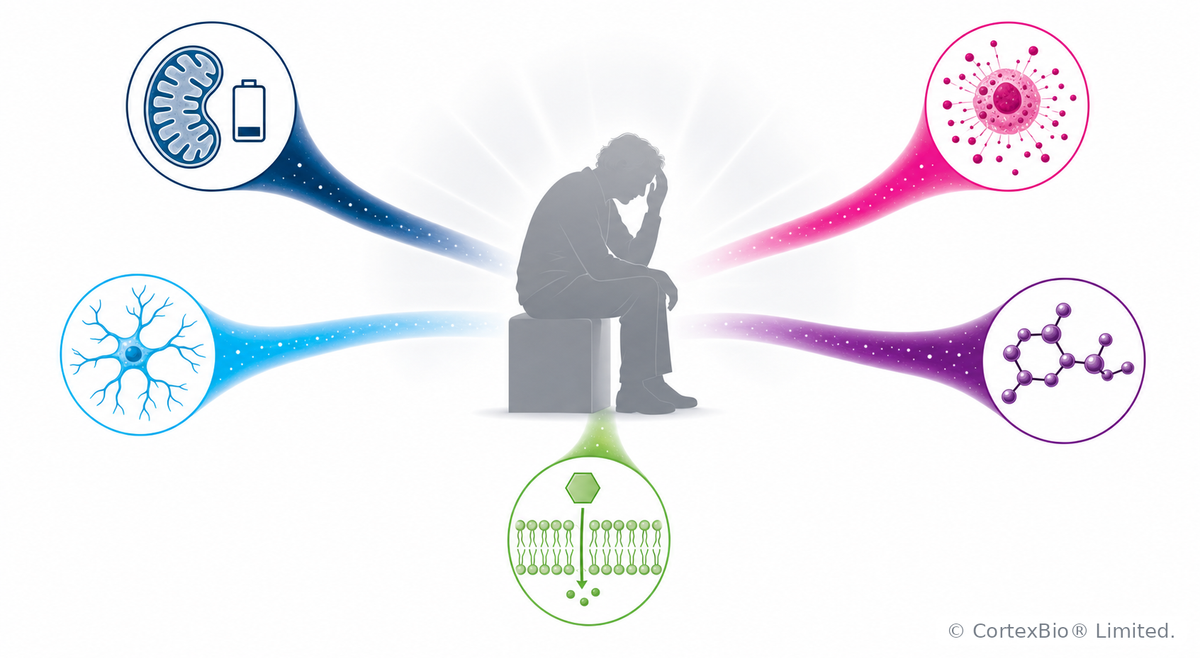
When an older person says "I'm exhausted," the word does an enormous amount of work — and most of it is invisible. Between 15% and 45% of adults over 65 report fatigue, with a pooled estimate of roughly 31% in the over-60s.1 That single word is asked to cover a cell that has run out of energy currency, a body simmering with low-grade inflammation, a brain whose immune cells are misfiring, a chemical imbalance starving the brain of serotonin, and a metabolism that can no longer handle its own fuel.
These are not shades of the same thing. They are five different machines breaking in five different ways, and at CortexBio® we think the habit of calling them all "fatigue" is one of the quietest failures in the medicine of ageing.
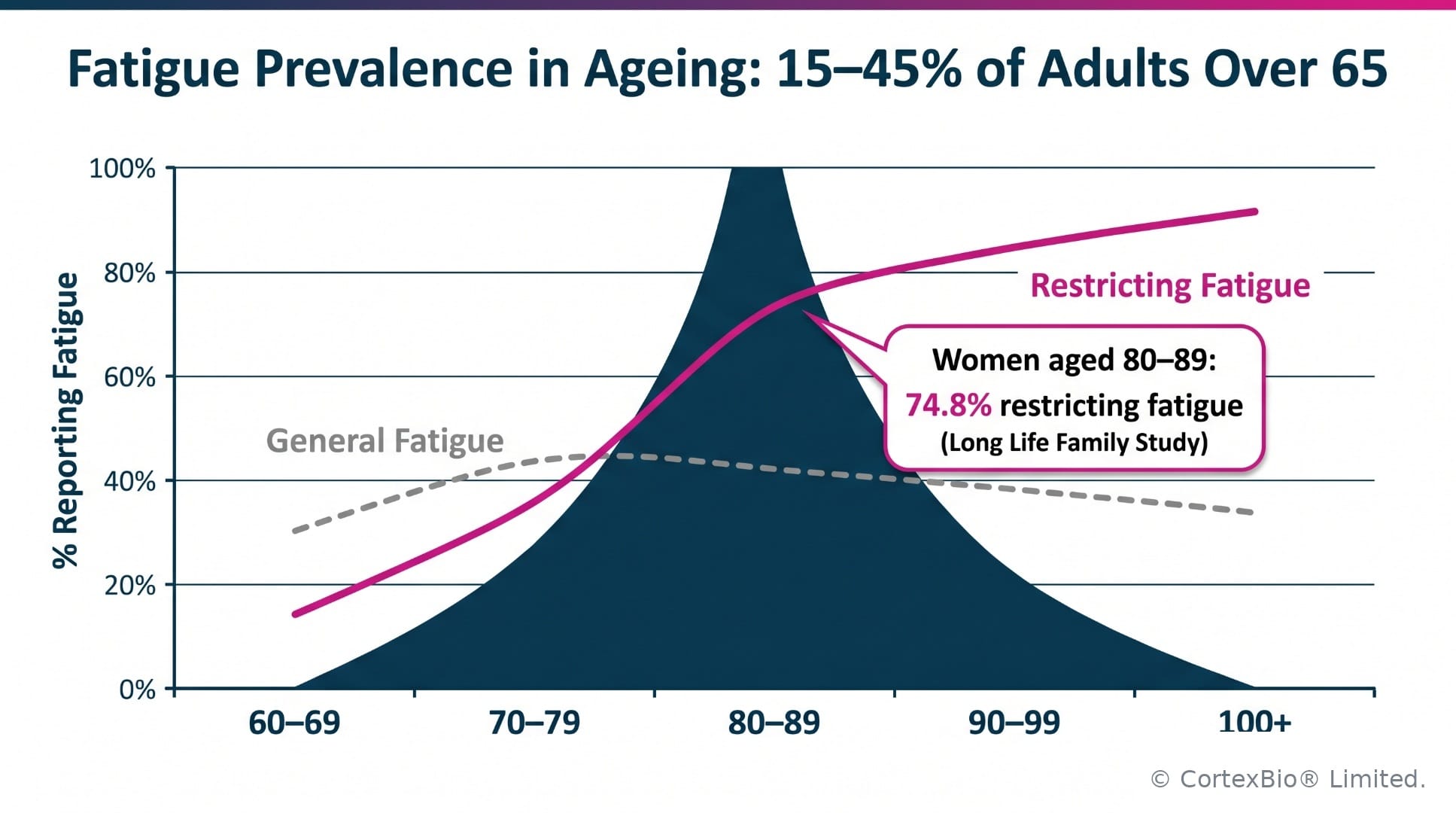
There is a detail here that surprises most people. General, everyday tiredness does not simply climb with age — in several large studies, older adults report less of it than the middle-aged, as expectations recalibrate.2 What rises steeply is something different: restricting fatigue, the kind severe enough to curtail what you do for months at a time. In women aged 80–89, one long-running family study found it present in 74.8%.3
Why one label stalls the science · 2 min
Here is the practical cost of the single word. Imagine four people who all score the same on a standard fatigue questionnaire. One has a cellular energy failure; one is inflamed; one has a brain-immune problem; one crashes after every meal because of insulin resistance. The questionnaire cannot tell them apart — yet they are unlikely to respond to the same treatment.4
So when a trial enrols all four and tests one intervention, the result is a diluted average — and often "no effect," even when the treatment works beautifully for one of the four. This is exactly the trap that cancer medicine climbed out of: tumours with the same name turned out to have different drivers, and progress only came once they were named and matched to the right therapy.5
The fix is not a better questionnaire. It is names that carry biology — so the right treatment can finally be tested in the right person. We have proposed five: a cellular-energy type, an inflammatory type, a brain-immune type, a serotonin-pathway type, and a fuel-handling type.6
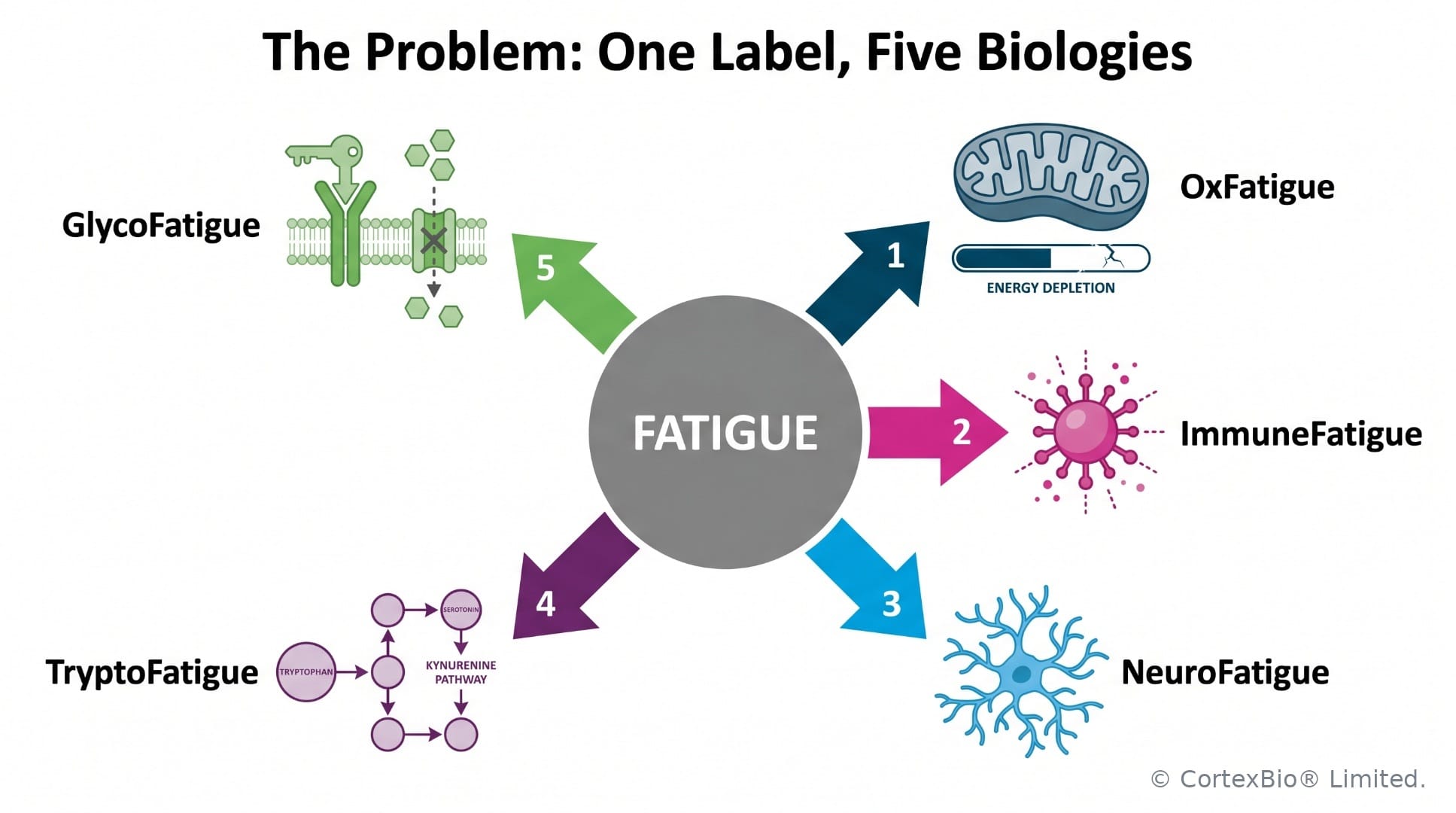
Which of the five is yours? That is the question this short article deliberately leaves open — because the honest answer needs a clinical assessment, not a guess. What you can do is start gathering the clues.
What to do with this, this week · 1 min
The clinical assessment framework — how to read those patterns into the five subtype signatures and match each to a marker and a measure — sits in CortexBio In Practice. £19/month, cancel any time.
The strategic and market-level implications — including why the therapeutic pipeline has stalled and how rare inherited diseases unlock the biology — sit in CortexBio In Consult. £49/month for the strategic tier.
This article centres British data, but the mechanism is global. In the United States, the CDC reports that fatigue is among the most common reasons older adults give for limiting their daily activity, with comparable patterns across the ageing population.7 Readers in Canada, Australia, and the European Union face the same biology with different system overlays.
Abbreviations used in this article
- CDC
- Centers for Disease Control and Prevention (United States)
References
- Yoon S, et al. Global prevalence of fatigue in the general population: a systematic review and meta-analysis. BMC Public Health 2024. Pooled fatigue prevalence approximately 31% in adults over 60. doi.org/10.1186/s12889-024-17753-1. ↩
- Moreh E, Jacobs JM, Stessman J. Fatigue, function, and mortality in older adults. J Gerontol A Biol Sci Med Sci 2010;65(8):887–895. doi.org/10.1093/gerona/glq064. ↩
- Simonsick EM, Glynn NW, Jerome GJ, et al. Fatigability in high-functioning adults: who is most susceptible? J Am Geriatr Soc 2016;64(4):736–742. doi.org/10.1111/jgs.14027. ↩
- Bower JE. Cancer-related fatigue: mechanisms, risk factors, and treatments. Nat Rev Clin Oncol 2014;11(10):597–609. doi.org/10.1038/nrclinonc.2014.127. ↩
- López-Otín C, Blasco MA, Partridge L, Serrano M, Kroemer G. Hallmarks of aging: an expanding universe. Cell 2023;186(2):243–278. doi.org/10.1016/j.cell.2022.11.001. ↩
- Martini-Drew D. Ageing fatigue subtypes: a mechanism-based nomenclature and translational research framework. CortexBio White Paper 2026;CB-FATIGUE-AGEING-01. cortexbio.co.uk. ↩
- Centers for Disease Control and Prevention. FastStats — older persons' health and limitations in daily activity. Atlanta: CDC; 2024. Available from: cdc.gov/nchs/fastats/older-american-health.htm. ↩