
263,865 joint replacements. An NHS waiting list over 800,000.
Britain's crumbling pavements tilt beyond legal limits — loading knees asymmetrically with every step. The infrastructure variable medicine has overlooked.
⚠️ Educational only. This article reflects published evidence and is not medical advice. Speak with your clinician before changing any treatment, supplement, or activity programme. This article does not constitute off-label use guidance for any medication. Where drug categories are mentioned, they are for educational reference only; specific clinical decisions remain with the prescribing clinician.
263,865 joint replacements across England, Wales and Northern Ireland in a single year. An NHS waiting list of more than 800,000 people for trauma and orthopaedic care. A £1.69 billion repair backlog for England's pavements. We treat all three as separate problems. They aren't.
The geometry of the surfaces we walk on every day — surfaces almost nobody thinks about — is quietly loading our joints beyond their design limits. Not dramatically. Not painfully. Just relentlessly, thousands of times a day, for decades. By the time the consequences show up in an orthopaedic clinic, the pavement has already done its work.
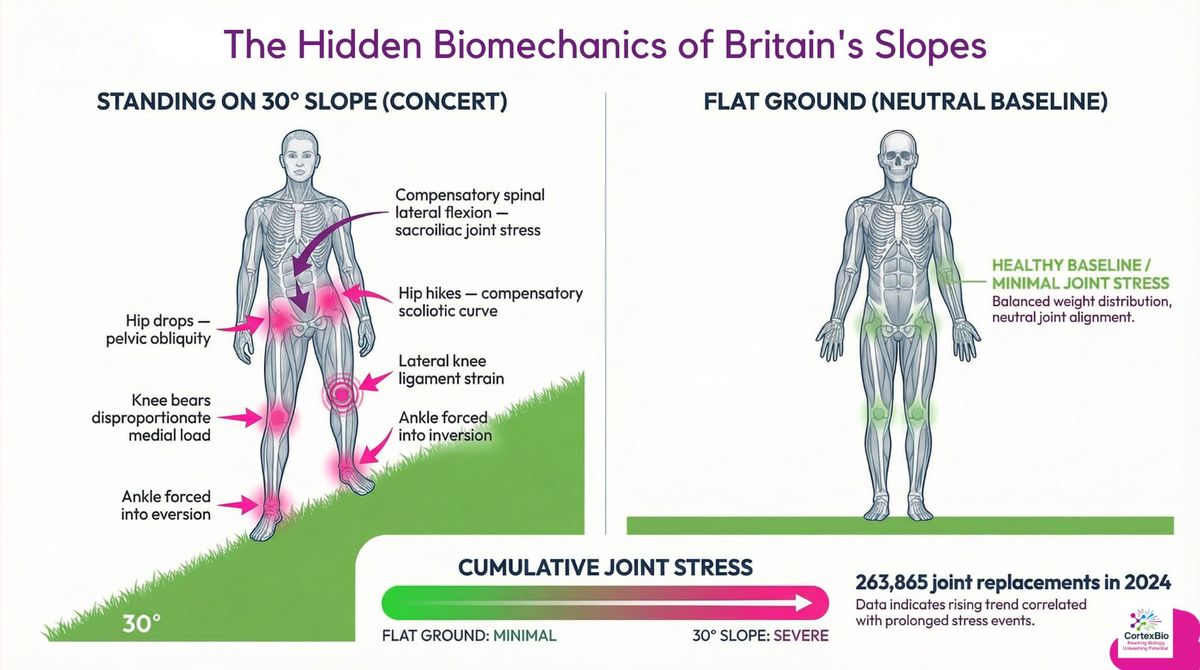
Last summer I watched ten thousand people sway to Tom Jones on the natural slope at Sandown Park racecourse in Esher. Wonderful evening. Terrible biomechanics. Almost nobody was facing uphill or downhill — they were standing laterally, one foot higher than the other, because that's how you face a stage on a slope. Hips tilted. Knees loaded asymmetrically. A single concert won't ruin anyone's knees. But a concert is a useful microcosm of a much bigger story playing out underfoot every day.
The pavement outside your front door
Here's a fact that surprises most people: every pavement in Britain is deliberately built on a slope. It's called crossfall — a slight lateral tilt that drains rainwater toward the gutter. Building standards say it shouldn't exceed about 2.5 per cent. In practice, years of subsidence, root damage, patching, and general neglect mean many pavements tilt at two to three times that limit. You don't notice it. Your knees do.
Every step on a cambered surface loads one leg differently from the other. The downhill knee absorbs more force. The uphill ankle works harder to stabilise. Walk ten thousand steps a day — a fairly average figure — and a significant proportion of them involve this quiet, asymmetric loading. Not dramatic. Not painful. Just relentless.
And Britain's pavements are getting worse, not better. The repair backlog for England's footways alone stands at an estimated £1.69 billion — and that figure excludes London entirely. Government funding overwhelmingly goes to roads, not pavements. Meanwhile, 31 per cent of older adults say they've been put off walking altogether because of the state of the paths near their homes.
The number we keep treating as inevitable
The National Joint Registry recorded 263,865 joint replacement procedures in its most recent reporting period: roughly 134,000 new knees and 117,000 new hips. The NHS waiting list for trauma and orthopaedic treatment alone now exceeds 800,000 people. If you go private, a knee replacement costs somewhere between £13,000 and £16,000.
These numbers are staggering, but we tend to treat them as an inevitable consequence of an ageing population. Knees wear out. Hips give way. That's just what happens when you get older. Isn't it?
Not entirely. Ageing is a factor, of course. But the rate at which your joints deteriorate isn't fixed. It depends, in part, on the cumulative mechanical stress they absorb over a lifetime. A flat pavement and a cambered one might feel identical underfoot. But the forces travelling through your knee on each step are quietly different. Multiply that difference by years, by decades, and the numbers start to matter.
Everyone has the potholes. Not everyone has the way out.
Here is the part nobody seems willing to say aloud. Cracked pavements aren't only a problem of the inner cities or "left-behind" places. The roads and footways are crumbling in Cobham, Weybridge, and Esher too — relatively prosperous corners of Surrey where you might expect better. Everyone, regardless of postcode, is walking on the same neglected infrastructure. The inequality lies somewhere else.
Research published in PLOS Medicine, using a decade of National Joint Registry data, found that inequalities in who actually receives joint replacement surgery have remained stubbornly constant. Communities with the highest levels of social deprivation consistently have lower rates of hip replacement — despite having, by every measure, greater clinical need. Some can pay £13,000–£16,000 to skip the queue privately. Many cannot. And nobody — not the NHS, not the Department for Transport, not the orthopaedic community at large — is talking about preventing the joint disease in the first place. Even though the prevention case is overwhelming: better outcomes for the individual, longer mobility, and consequentially (not as the headline) lower cost to the system.
And the countries that beat us on every measure — happiness, healthy years lived, joint health into old age — are the same ones that spent decades building walkable streets and maintaining their pavements. Britain ranks near the bottom of comparable high-income nations on healthy life expectancy. That is not a coincidence. It is a question worth asking: if your pavements are crumbling and your streets are built for cars, should you really be surprised when your joints follow suit?
The ground is a health issue
We spend billions on drugs, surgical techniques, and rehabilitation programmes for joint disease. We spend comparatively little on the surfaces that contribute to it. Nobody argues that pavement crossfall causes osteoarthritis in a simple, linear way. Biology is messier than that. But the accumulation of millions of asymmetric, biomechanically suboptimal steps — on surfaces that quietly exceed their own design standards — is a variable we have almost entirely ignored.
We regulate ramp gradients in buildings. We mandate handrails. We specify maximum slopes for wheelchair access. Yet we cheerfully pack ten thousand people onto a thirty-degree hillside for an evening's entertainment and never mention their knees. And we let the pavements they walk home on afterwards crumble past their own safety limits without a second thought.
The next time you're walking to the shops, or standing on a slope watching live music on a warm Surrey evening, glance down. Feel the tilt beneath your feet. Notice which knee is working harder. Then consider that your joints have been doing that calculation, silently, for your entire life.
The other half of the British infrastructure problem isn't the camber. It's the impact. Potholes, kerb drops, and uneven pavements deliver thousands of micro-shocks a year up through your skeleton — and the molecular consequences are different from cumulative camber loading. We trace the biology of impact and ask why neither has a public-health programme attached to it.
For more on the biology behind everyday environments, visit CortexBio.
This is the surface — there's a clinical layer beneath it.
In Practice members get the evidence: how cambered surfaces drive measurable molecular ageing, the NHS waiting-time hourglass, and what 18 peer-reviewed studies actually say. → Read the clinical layer · upgrade to In Practice
Cite this article: 10.5281/zenodo.20140593
Full research paper: Martini-Drew D. The ground beneath your feet: sloped venues, cambered pavements, and infrastructure decay accelerate metabolic ageing. CortexBio Limited; 2026. doi:10.5281/zenodo.20140593 (Embargoed until 8 November 2026)